Back to Imberion
How it works

A connected system.
Three distinct capabilities.

Built to work as a full loop — or deployed where the need is greatest.

A Information Infrastructure B Intelligence Layer C Execution & Value Capture
A
Information Infrastructure

We build the visibility
you don't have yet.

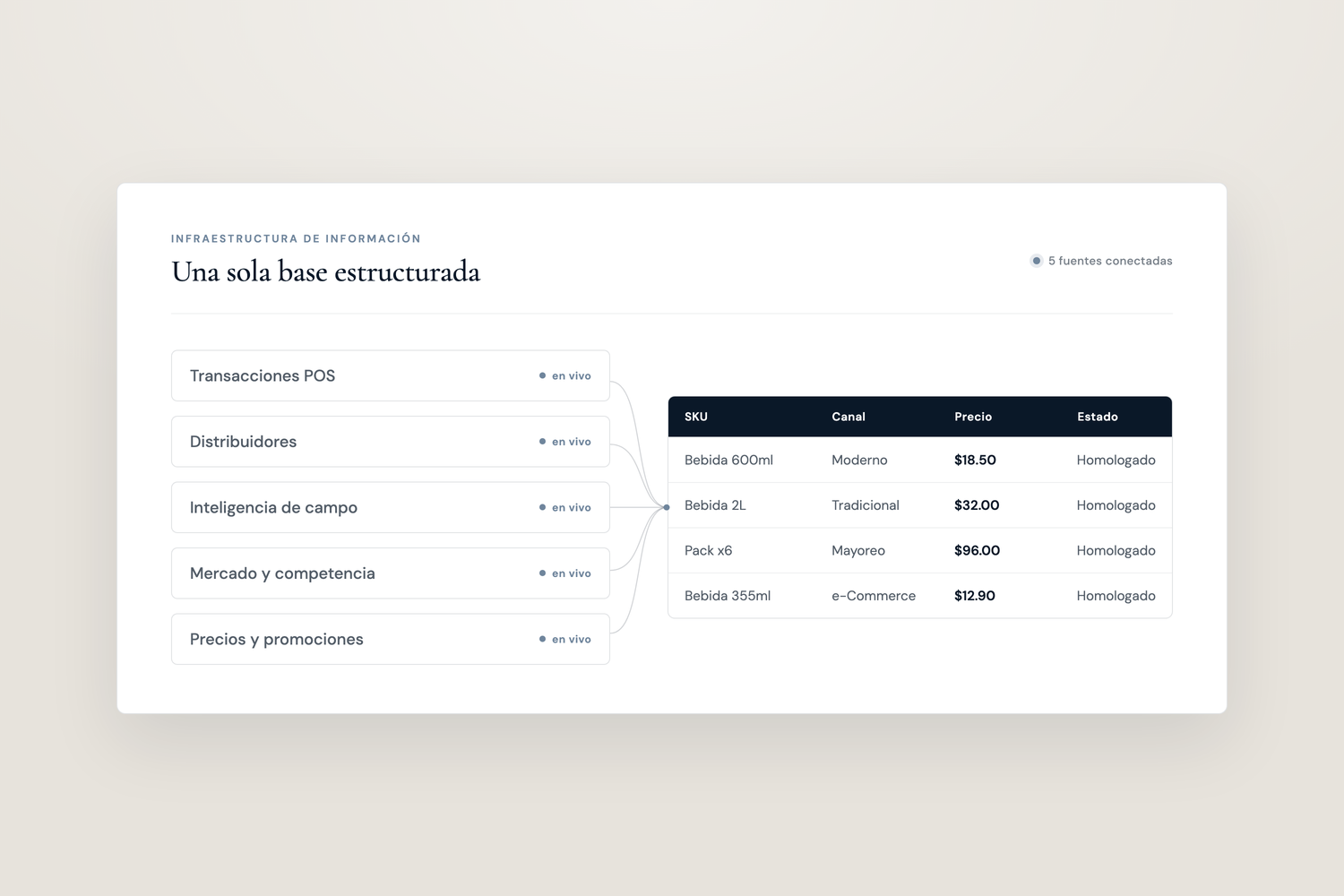
Most organizations cannot see their market clearly — not because the data doesn't exist, but because it has never been consolidated into a single reliable base. Arm A resolves that before anything else can be attempted.

Structured Sources

Internal transactional data

ERP, sales systems, and billing records — the data the client already owns but rarely consolidates.

Traditional channel POS

Point-of-sale capture from fragmented traditional trade where traceability is typically low.

Modern channel POS

Transactional data from structured retail chains and modern trade formats.

Distributor integrations

Structured connections to receive and map sales, coverage, pricing, and promotional data.

Syndicated market data

Third-party aggregated sources for benchmarking and market-level reads.

Product & price catalogs

SKU master data, price lists, promotional calendars, and inventory records.

Unstructured & Missing Sources

Field surveys

In-field capture for prices, inventory, promotions, visibility, competitive presence, and compliance.

Sales force reports

Route-level intelligence from commercial teams operating at the point of sale.

Shelf & in-store intelligence

Assortment compliance, share of shelf, pricing execution, and promotional display tracking.

Competitive price monitoring

Observed competitor pricing at point of sale by channel, region, and format.

Market studies & benchmarking

External research and category benchmarks that provide context beyond internal data.

Consumer & shopper research

Demand-side intelligence to complement supply-side and transactional data.

1

Data Capture

Direct capture from POS systems, surveys, apps, and integrations. The entry point for all commercial information.

2

Data Ingestion

Technical loading of multiple sources into a common architecture — regardless of format, cadence, or origin.

3

Data Cleansing

Correction, validation, deduplication, and resolution of inconsistencies. A reliable base starts here.

4

Harmonization

Standardization of SKUs, customers, channels, and geographies so data becomes comparable across sources.

5

Data Asset Creation

Generation of structured, usable datasets for analytics, benchmarking, and eventual monetization.
A — Information Infrastructure
B — Intelligence Layer
B
Intelligence Layer

We convert visibility
into commercial decisions.

Eight analytical capabilities that transform structured commercial data into prioritized actions — not reports. Trade-offs made explicit. Decisions, not recommendations.

Pricing & Pack Architecture

Design prices and pack structures with economic rigor, demand sensitivity, and behavioral validation across channels and formats.

Demand Moments & Occasions

Map when and where consumers engage — and configure the offer, price, and pack accordingly by occasion and channel.

Predictive Elasticities

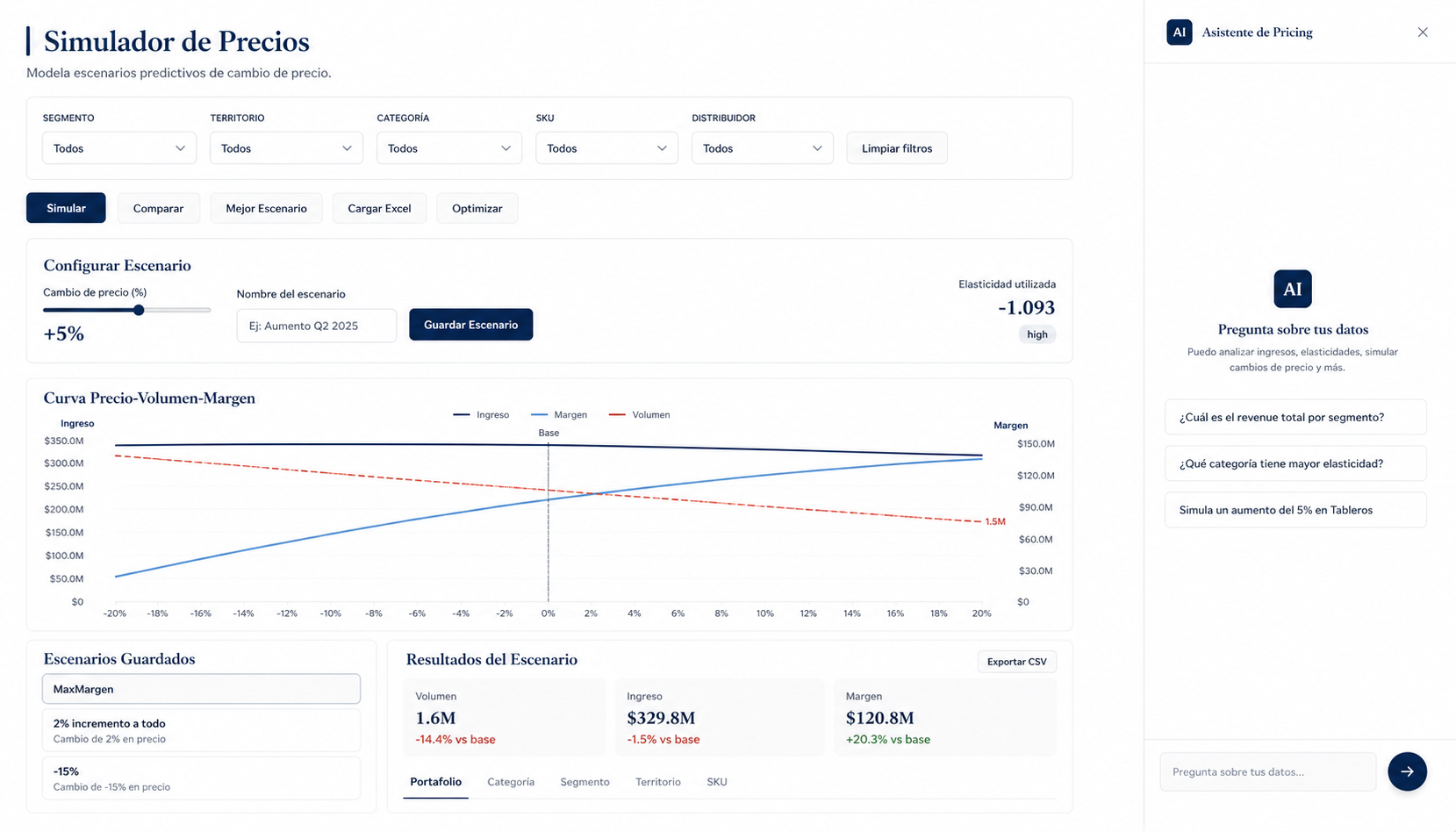
Simulate how volume and margin respond to price moves before committing. Test scenarios across SKUs, segments, and markets.

Promotion Intelligence

Distinguish promotions that create genuine value from those that displace volume, destroy margin, or cannibalize adjacent SKUs.

Trade Terms Optimization

Trace margin erosion from list price to pocket — and redirect trade spend where it generates measurable commercial return.

Portfolio & Assortment

Design the right offer for each format, channel, and occasion. Identify where current coverage leaves demand uncaptured.

Competitive Intelligence

Track competitor pricing, pack architecture, and promotions in real time at the point of sale — by channel, region, and format.

Channel & RTM Strategy

Prioritize routes to market by value potential, coverage capacity, and commercial coherence. Align deployment to where the system can win.

Pricing simulator — scenario modeling interface
Pricing & scenario modeling interface
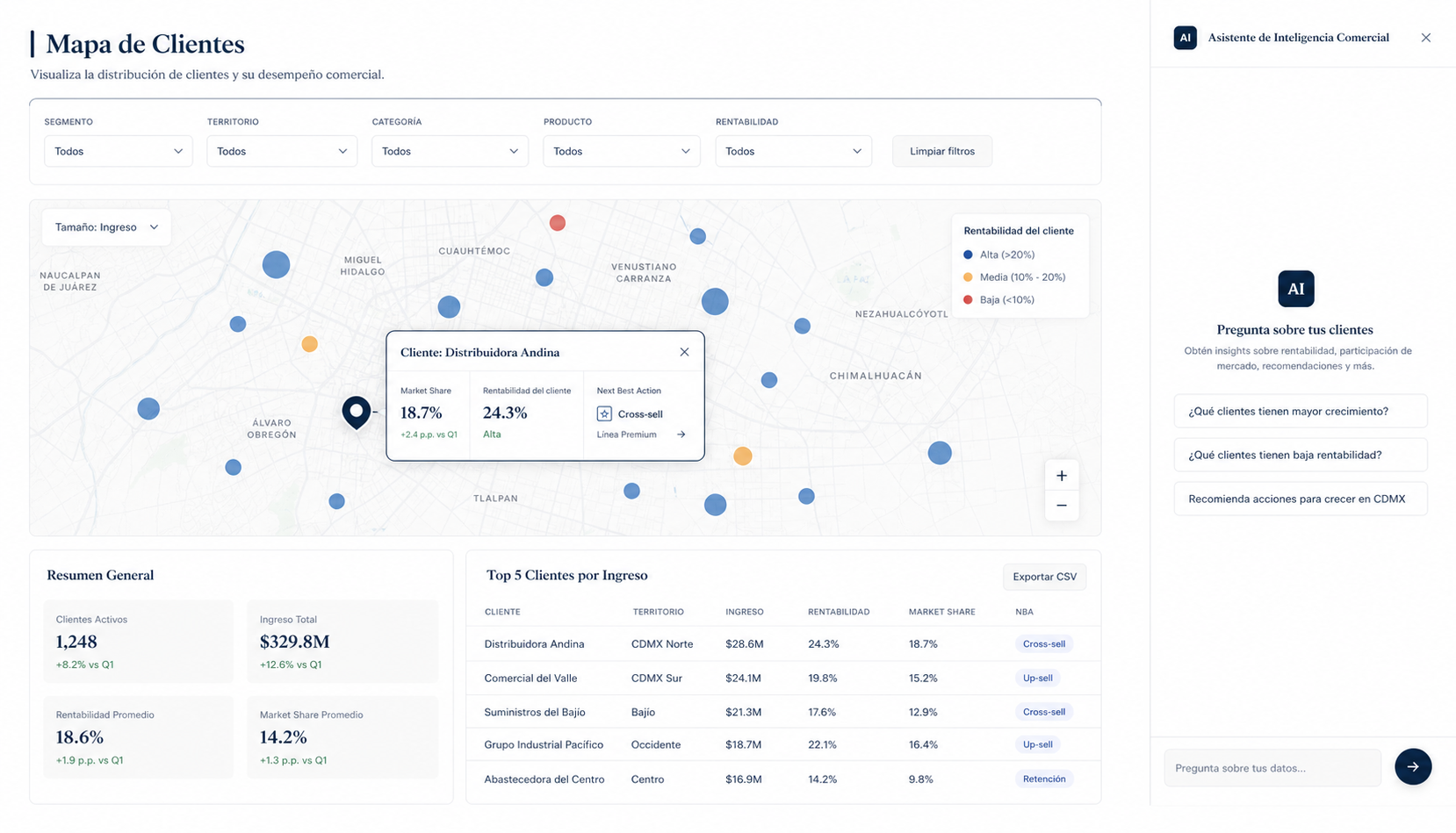
Client coverage map
Client coverage map
B — Intelligence Layer
C — Execution & Value Capture
C
Execution & Value Capture

We stay until
the value is captured.

Most systems stop at the recommendation. Arm C is where the work becomes real — intelligence translated into field action, measured against baseline, and fed back into the system.

The distance between a good analysis and a measurable commercial result is where most systems — and most consulting engagements — fail. We do not hand off a deck and disengage.

Decision Translation

Analysis into prioritized actions

B output converted into a specific, sequenced action list — what gets done first, what gets done second, what does not get done at all — with responsible owners and timelines.

Action Plans

Decisions into concrete plans

Decisions structured into field-ready plans by commercial, trade, key account, and territory — with the specificity required for execution, not just communication.

Field Enablement

Working alongside execution teams

We do not hand off the plan. We work alongside the teams responsible for execution until the logic operates on its own — training, real-time support, and adaptation when field signals reveal gaps.

KPI Tracking

Measuring what actually happened

Performance dashboards and cycle-by-cycle variance analysis built in from the start. Results measured against a pre-defined baseline — not against internal perception of progress.

Governance

Execution discipline across cycles

Structured review cadence, escalation paths, and accountability frameworks to maintain commercial discipline beyond the initial deployment — institutionalizing the logic, not just the output.

Learning Loop

Feeding results back into the system

What Arm C learns in execution is not lost. Structured and returned to the analytical models, the data infrastructure, and the priority framework — so every cycle is more informed than the last.

The loop closes

Execution feeds the system.
The system improves.

Every cycle returns structured learning to Arm A and Arm B — making the data richer, the models sharper, and the decisions more precise. The system compounds.

A

Information

Market data structured and consolidated

B

Intelligence

Data converted into decisions

C

Execution

Decisions captured in the field

Learning

Results feed back into A & B